
NFL Prop Bet Odds Formats: Decimal, Fractional and American
 Available in US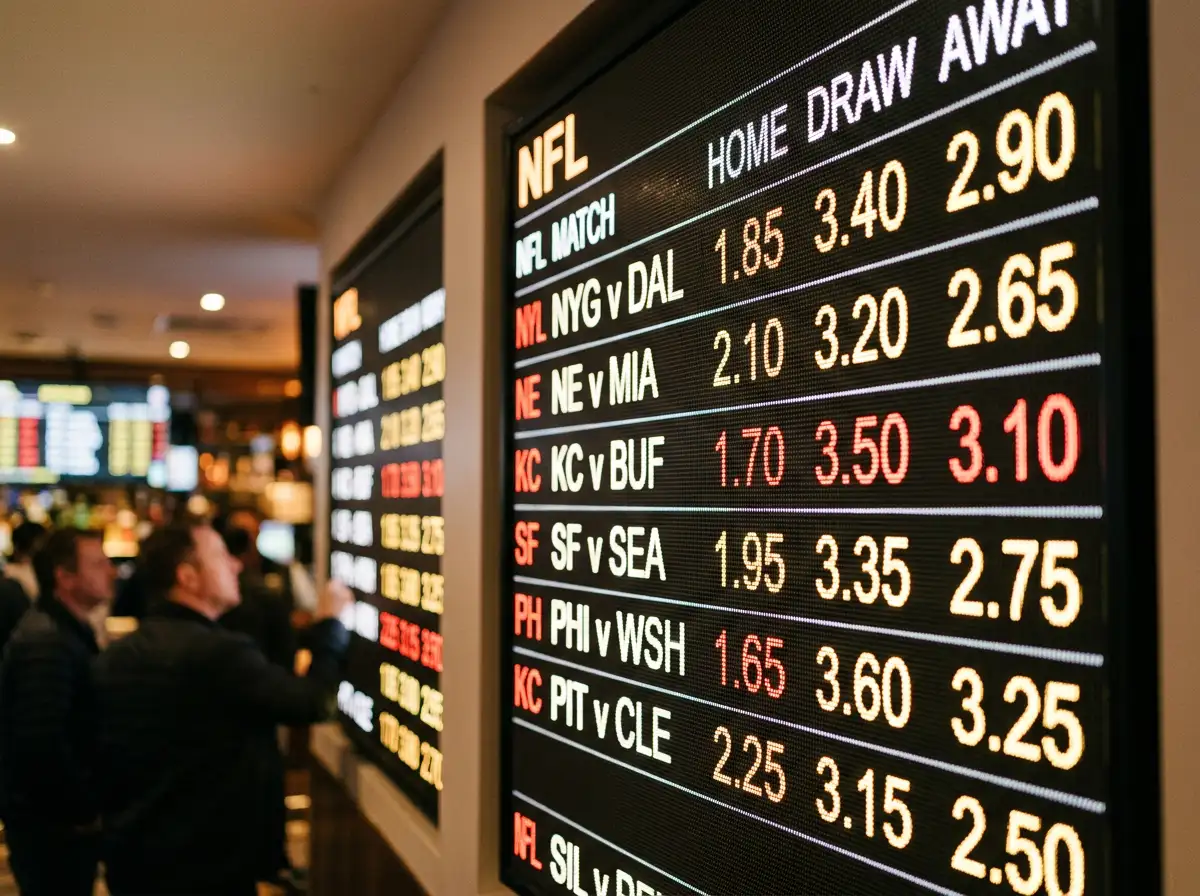
The first time I tried to follow an American NFL betting podcast, I nearly gave up within ten minutes. The host kept saying things like “-110” and “+250” as if everyone on the planet spoke that language. I didn’t. As a UK punter raised on decimal odds and the occasional fractional price at the high street bookies, American odds format felt like reading a bank statement in a foreign currency. It took me a weekend of scribbling conversions on a notepad before things clicked – and once they did, I realised that understanding all three formats isn’t just academic. It’s the foundation for spotting value across different markets.
This guide breaks down how decimal, fractional and American odds work for NFL props, shows you how to convert between them, and explains why the gap between the odds you see and the true probability of an outcome is where bookmakers make their money.
Decimal Odds Formats at UK Prop Betting Sportsbooks
If you bet at any UKGC-licensed bookmaker, decimal odds are almost certainly your default display. They’re also the simplest format to understand, which is why Europe – the continent that holds the largest share of the global sports betting market at roughly 44% – overwhelmingly uses them.
Decimal odds tell you exactly what your total return will be per unit staked, including your original stake. If a prop is priced at 2.20, a 10 pound bet returns 22 pounds – 10 pounds back plus 12 pounds profit. No mental gymnastics required. The number always represents the multiplier on your stake.
For NFL player props, UK bookmakers will typically display lines like this: “Travis Kelce Over 4.5 Receptions – 1.83.” That 1.83 means you get 1.83 times your stake if Kelce catches 5 or more passes. The implied probability is 1 divided by 1.83, which gives you roughly 54.6%. In other words, the bookmaker’s model suggests there’s about a 54.6% chance Kelce hits 5+ receptions.
Where it gets important: the implied probabilities on both sides of a prop (over and under) will always add up to more than 100%. If the over is 1.83 (54.6%) and the under is 2.05 (48.8%), the combined implied probability is 103.4%. That extra 3.4% is the overround – the bookmaker’s built-in margin. It’s why the house always has an edge in the long run, and it’s why understanding odds formats is a practical skill, not a theoretical one.
Decimal odds also make comparing lines between bookmakers dead simple. If one book prices a prop at 1.90 and another at 1.95, you don’t need a calculator to see which offers better value. That clarity is one reason I’ve never switched away from decimal display, even when American sources tempt me with their format.
Converting Between Odds Formats
I keep a conversion cheat sheet on my phone. Not because the maths is hard, but because doing it quickly during a live betting window matters – and fumbling with fractions when a line is about to move is a luxury you can’t afford.
Here’s how each format translates. Decimal to fractional: subtract 1 from the decimal, then express as a fraction. Odds of 3.50 become 2.50/1, which simplifies to 5/2. Decimal to American: if the decimal is 2.00 or higher, the formula is (decimal – 1) multiplied by 100, giving you the positive American number. So 3.50 becomes +250. If the decimal is below 2.00, divide -100 by (decimal – 1). So 1.67 becomes -100 divided by 0.67, which is roughly -149.
Going the other direction – American to decimal – is what you’ll need when reading US-based prop analysis. For positive American odds, divide by 100 and add 1. So +200 becomes 3.00. For negative American odds, divide 100 by the absolute value, then add 1. So -150 becomes 1 divided by 1.5, plus 1… actually, let me put it more cleanly: 100 divided by 150 = 0.667, plus 1 = 1.667. Round to 1.67.
Fractional to decimal is the easiest: divide the first number by the second and add 1. So 5/2 = 2.5 + 1 = 3.50. Fractional odds are still common at traditional UK bookmakers, especially in horse racing, but for NFL props they’re increasingly rare. Most online platforms default to decimal, and I’d recommend keeping it that way.
The reason this matters beyond convenience: if you’re reading American analysis that says a prop has “+180 value” and you can’t instantly recognise that as 2.80 in decimal, you’ll either miss the bet or misvalue it. The NFL prop betting community is global, and the sharpest analysis often comes from US-based modellers who speak exclusively in American odds. Learning the translation is non-negotiable if you want access to that research.
Implied Probability and Overround
Here’s where most beginners stop paying attention, and it’s exactly where they should start. Every set of odds encodes a probability estimate. Strip away the format – decimal, fractional, American – and what you’re left with is the bookmaker’s assessment of how likely something is to happen. Your job as a bettor is to decide whether that assessment is accurate.
Converting decimal odds to implied probability is the simplest calculation in betting: 1 divided by the decimal odds, multiplied by 100. Odds of 2.00 = 50% implied probability. Odds of 1.50 = 66.7%. Odds of 4.00 = 25%. Once you internalise this, every prop line becomes a statement you can agree or disagree with.
The overround – sometimes called the vig, juice, or margin – is how bookmakers guarantee profit regardless of outcomes. On a fair coin toss, both sides should be priced at 2.00 (50% each, totalling 100%). In practice, a bookmaker might price both at 1.91, giving an implied total of 104.7%. That 4.7% overround is the house edge. On NFL props specifically, the house edge tends to run higher than on straight match bets, because prop markets are less liquid and less scrutinised by sharp money. Average hold rates among major operators have climbed from around 6-7% in 2021 to 9-11% by 2025, driven largely by parlay and prop products.
What this means for you: every prop bet you place starts at a mathematical disadvantage. The overround is the price of admission. Profitable prop betting means finding spots where your estimated probability exceeds the bookmaker’s implied probability by enough to overcome that margin. If a bookmaker implies a 55% chance on a player prop over, and your analysis puts the real probability at 62%, you have a genuine edge – roughly 7 percentage points of value after accounting for the vig. If your edge is only 1-2%, it’s not enough to overcome variance over a meaningful sample.
Understanding this framework transforms how you look at every prop line. You stop asking “will this happen?” and start asking “is this price fair?” That shift in thinking is the single biggest upgrade a beginner can make.
How do I convert American odds to decimal for NFL props?
For positive American odds, divide by 100 and add 1. So +200 becomes 3.00 in decimal. For negative American odds, divide 100 by the absolute value and add 1. So -150 becomes 1.67 in decimal. This conversion is essential when reading US-based NFL prop analysis, which almost always uses American format.
How do I calculate implied probability from decimal odds?
Divide 1 by the decimal odds and multiply by 100. For example, odds of 1.80 give an implied probability of 55.6% (1 divided by 1.80 = 0.556). Comparing this implied probability to your own estimate of the true likelihood is how you identify value in NFL prop markets.
Published by the top nfl Prop Bets team.